Design leadership · Research · Validation · Delivery
Rebuilding the authoring platform
I led design for the replacement of Amplience’s schema-generated authoring platform, transforming a rigid, delivery-led model into one customers could shape around their own workflows.
Comparative SUS: 49 → 86 100% of customers migrated voluntarily Legacy authoring retired
Project summary
An authoring platform that wasn’t designed for authors
Amplience’s content management platform was optimised for fast, reliable delivery to customers’ digital storefronts. Thousands of different JSON Schema content models were automatically rendered into forms for authors to populate with campaign content. As those models grew more sophisticated, some required hundreds of individual fields. Authors were left navigating huge, auto-generated forms that were difficult to understand and complete under the pressure of a fixed campaign go-live date.
Evolution of the authoring platform
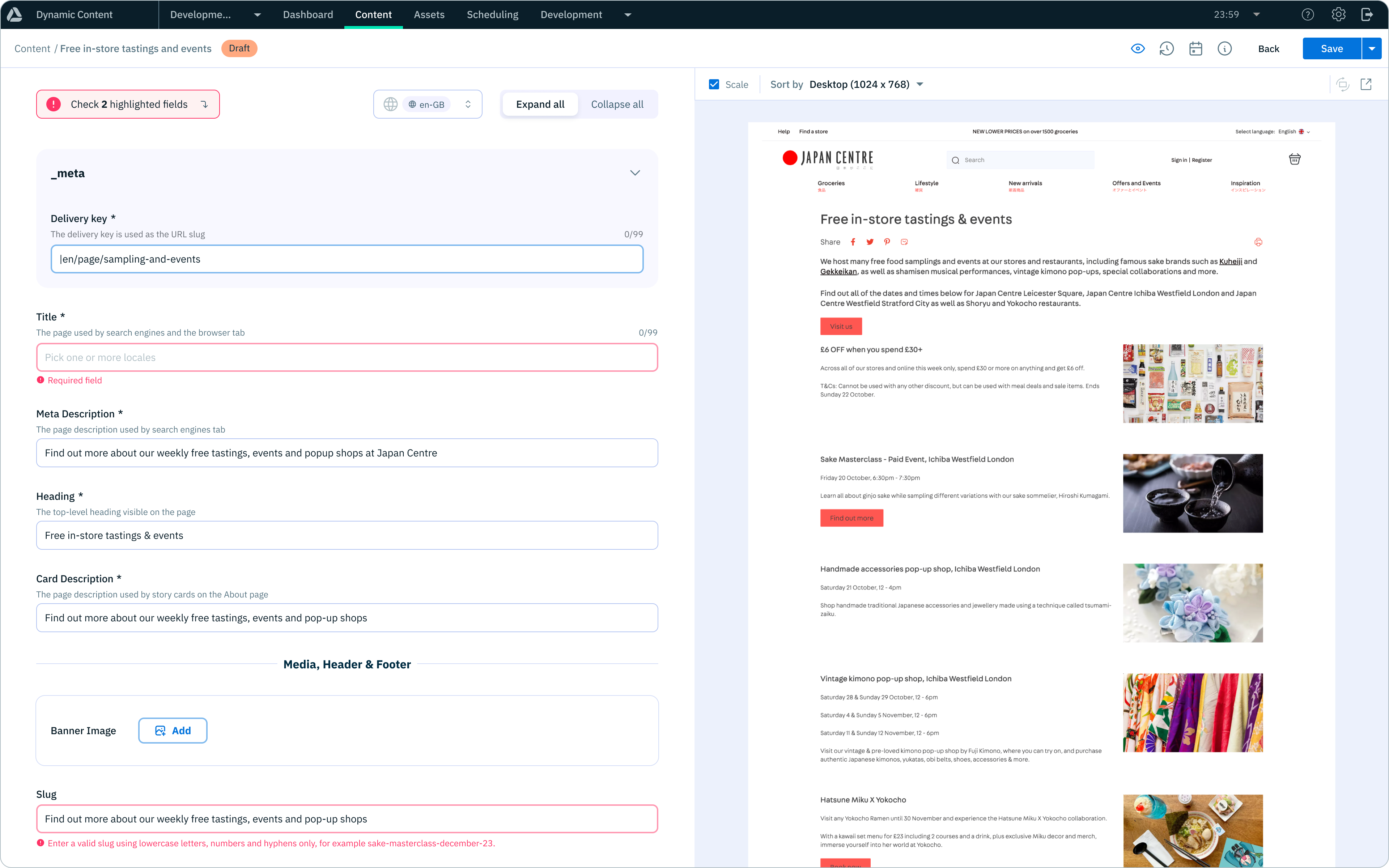
3 examples, for different content models, showing the legacy authoring platform, the experience the team and I shipped in 2026, and the final redesign that incorporated the new design system and addressed research insights uncovered during the project.
Research & discovery
A problem customers couldn’t avoid
The authoring form was an unavoidable part of the CMS workflow and generated some of the highest tracked activity in the product. With the Product Owner and researcher, I synthesised years of customer evidence and ran new research sessions to understand what the next authoring model should be, and test competing stakeholder preferences for different authoring models.
A freeform approach that represented a departure from structured authoring was well received as a concept, but did not match customers’ existing content-production workflows. Instead, customers wanted the structured model they already used to be substantially improved.
That gave us the product steer: preserve structured authoring, but make it easier for authors to work with.

Authors worked under time pressure at the end of the campaign-production chain, often struggling to orient themselves or know what was expected. They wanted simpler views, clearer guidance and more control, without losing the structure they relied on.
I audited six competing CMSs against those needs, comparing hierarchy, navigation, guidance, validation and complex-content patterns. Together, the customer evidence and audit gave us the principles for the redesign.

System foundations
A better base system
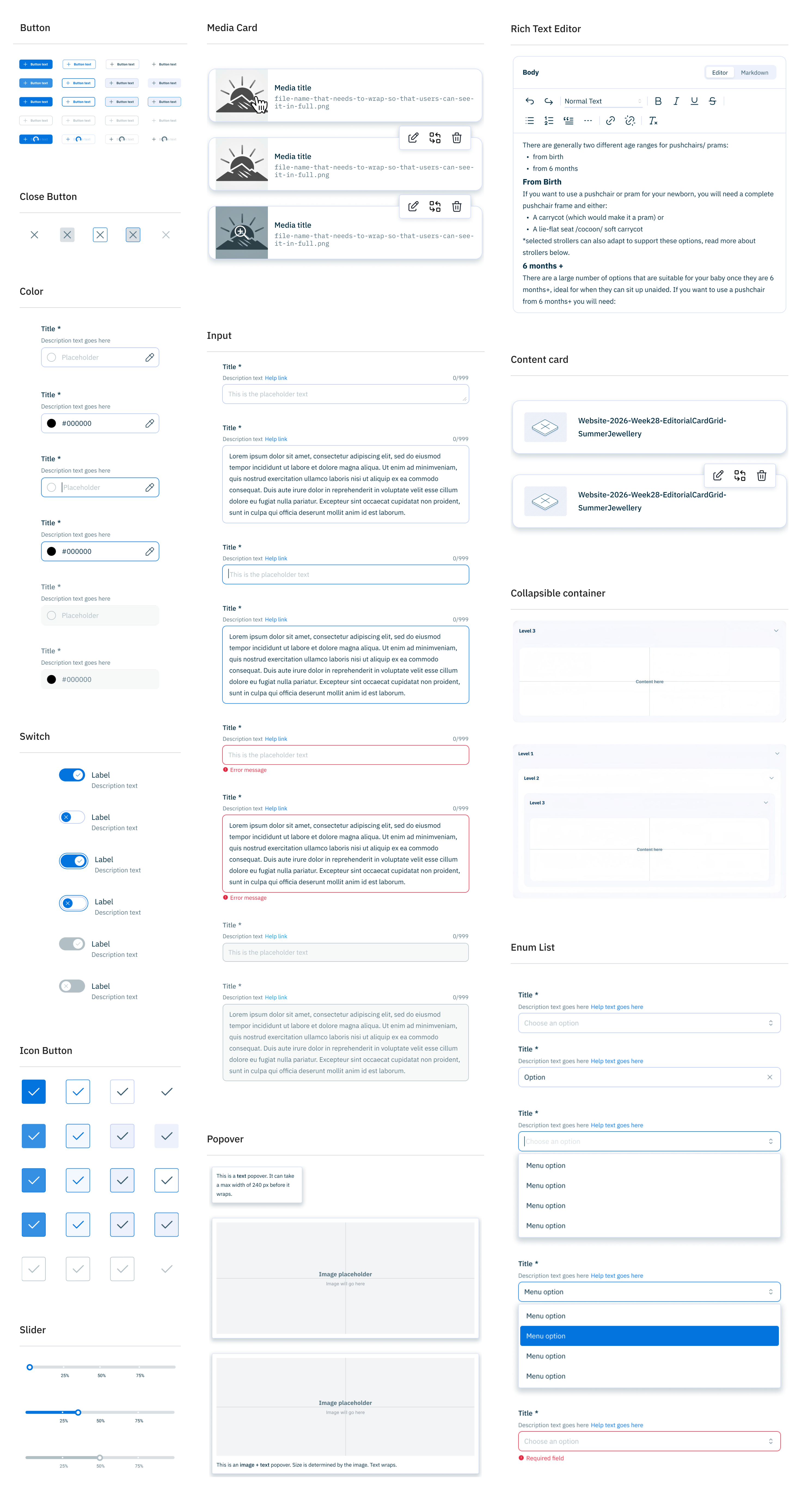
The competitor analysis informed a stronger baseline for every generated form, so even unchanged schemas benefited from a better authoring experience.
I designed complex components around authors’ mental models rather than the underlying data structure, surfacing titles, metadata and other recognition cues instead of forcing people to rely on a system representation that prioritised images.
These foundations expanded the native schema capabilities available to customers, reducing reliance on extensions.
Authoring patterns
Human control layer
Even with an improved base system, the schemas still dictated the shape of the generated form, whether or not that structure made sense to the author.
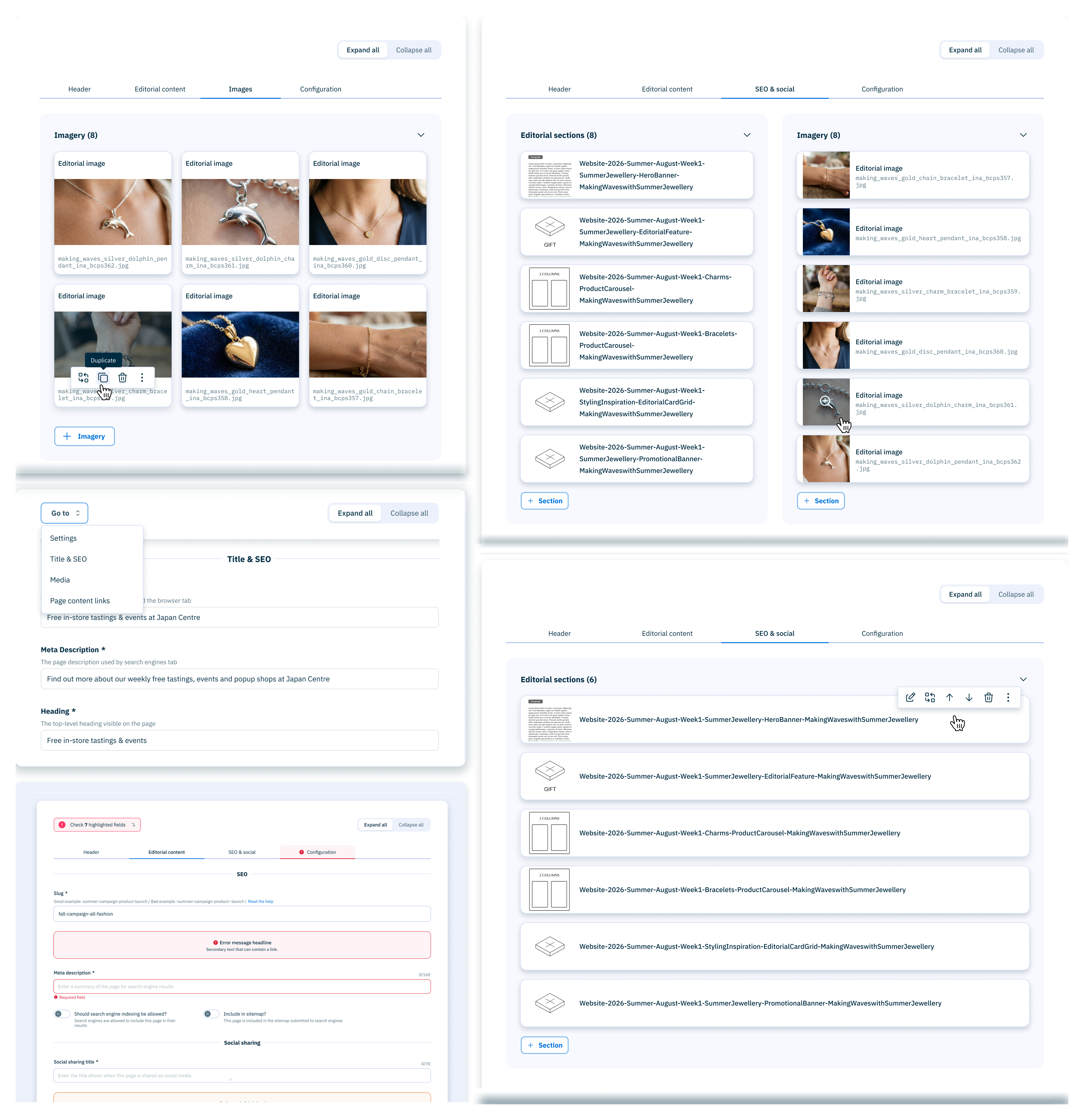
I introduced authoring-only structures that let customers organise machine-generated forms around how authors actually worked, without changing the data the CMS delivered to the frontend. Tabs, dividers, fieldsets and conditional content became a human-control layer over the generated experience.
Together, the stronger base system and authoring-only structures answered the recurring customer asks we had heard in research: simpler, role-relevant forms, clearer guidance, fewer irrelevant fields, stronger validation and a more consistent experience.
Building confidence
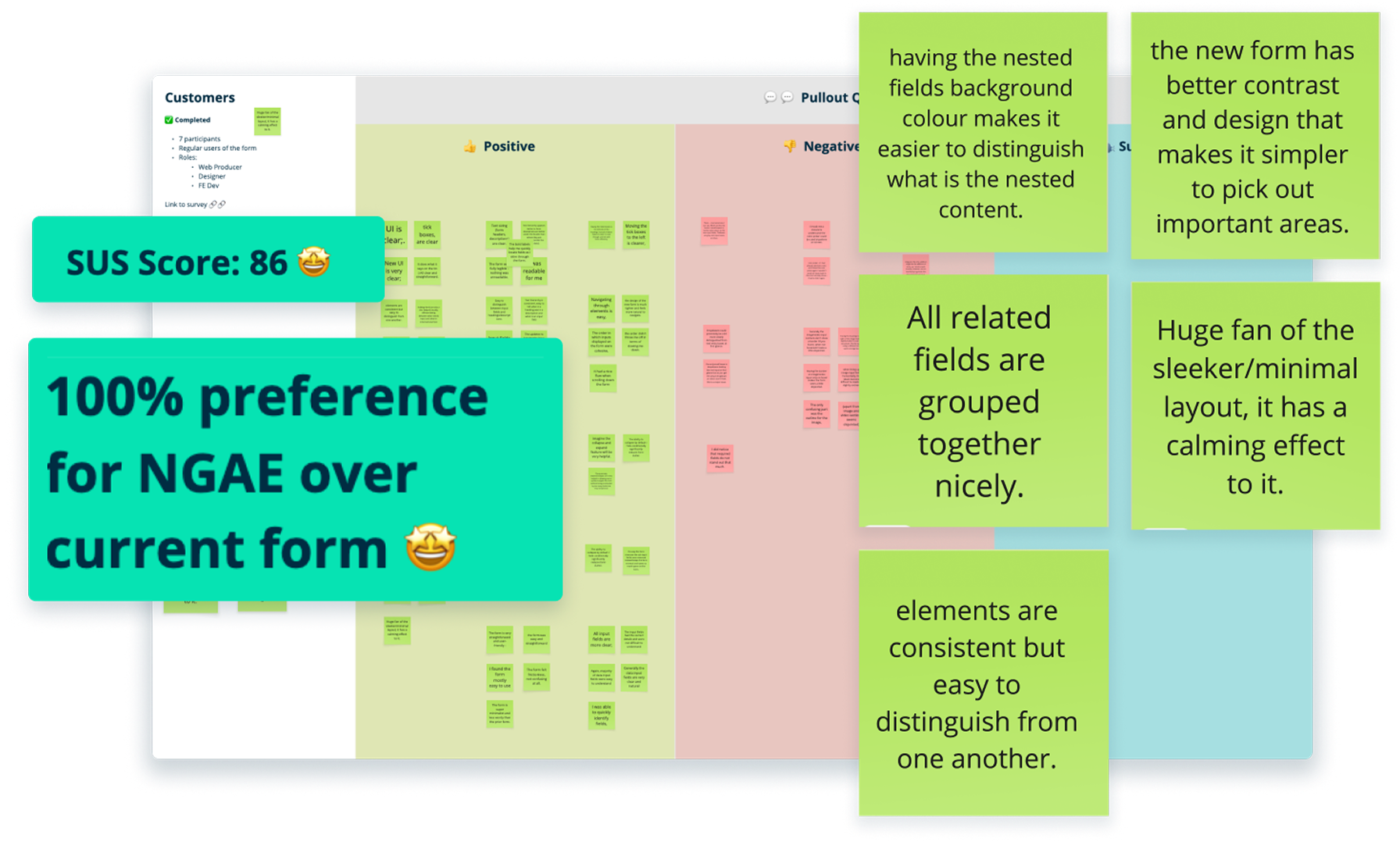
SUS 49 → 86. 100% preferred the new experience
Before Beta, the project sponsor asked us to prove the redesign was better than Legacy. I designed a comparative usability study across both editors. The results cleared the Beta gate and gave stakeholders confidence to progress the rollout.
Design trade-offs
What we didn’t do
Research had shown that customers valued freeform authoring as a capability, but did not want to replace the structured model they already used. Rather than build a new freeform authoring model, I reframed freeform as a staged MVP using existing patterns. That let us test its value without committing the platform to a second authoring model, while reducing implementation cost and protecting delivery cadence.


Product extensions
POC → signing prerequisite
Matrix began as a size-guide POC. The Product Owner and I were asked to productise it. We workshopped hypothetical usage scenarios with 7 customers. This revealed that size guides typically arrived ready-made from manufacturers, so a single Matrix widget would mainly improve codebase hygiene, not revenue, and was therefore a low priority.
Customer research revealed a broader commercial opportunity in buyer guides and other comparison content. I translated that into an expanded Matrix design beyond the original size-guide use case. Doing so required us to extend the feature. Two prospects later made Matrix a condition of signing.


Adoption
100% customer migration
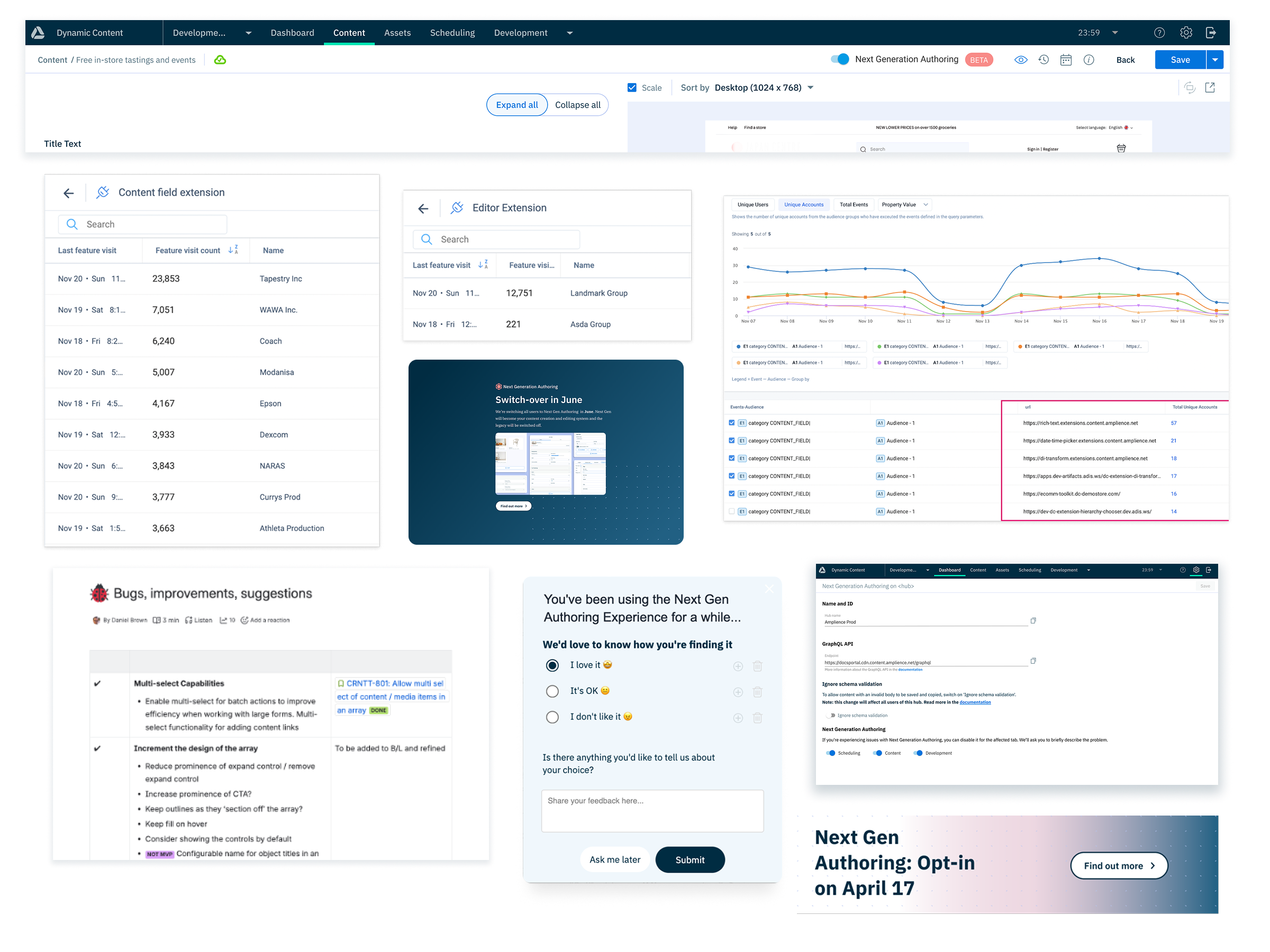
Legacy and Next Gen ran in parallel during rollout, giving us a live view of how customers adopted the new authoring structures in real content models. I used usage data, in-product feedback and direct customer contact to identify migration blockers, observing how teams applied the new patterns and refining the designs in response to real-world usage.
This was a platform replacement rather than a feature launch, so the adoption phase ran over an extended period: every existing customer schema had to work reliably before Legacy could be retired.
I separated systemic issues from customer-specific ones, using that evidence to prioritise the backlog without overfitting the product to individual accounts. That work drove 100% voluntary migration, giving us the confidence to retire Legacy.
Reflections
Where the work landed
Shipped product and future direction
The new authoring platform shipped in 2026 and every customer migrated to it, allowing Legacy to be retired. In parallel, I developed and customer-tested a broader redesign of the authoring workspace, applying the new design system across the experience. That direction was approved, but had not been implemented when I left Amplience.
Designing the decision architecture
The scale of the platform stretched both discovery and adoption. At the start, we genuinely did not know what should replace the existing authoring model, so we had to explore competing directions before committing. At the other end, replacing the platform meant proving the new model across the full diversity of customer schemas before Legacy could be retired.
What I underestimated was how much a programme of that scale also needed an explicit decision architecture. I focused heavily on generating the right evidence, but was less deliberate about mapping who needed to make each decision, what evidence would be sufficient to close it, and when exploration should give way to commitment.
If I ran a programme like this again, I would establish those rules much earlier. The design direction was broadly right, but clearer decision rights and decision gates would have helped us move through uncertainty with less friction and avoid reopening choices once they were embedded across the platform.